Topic
Ventilation
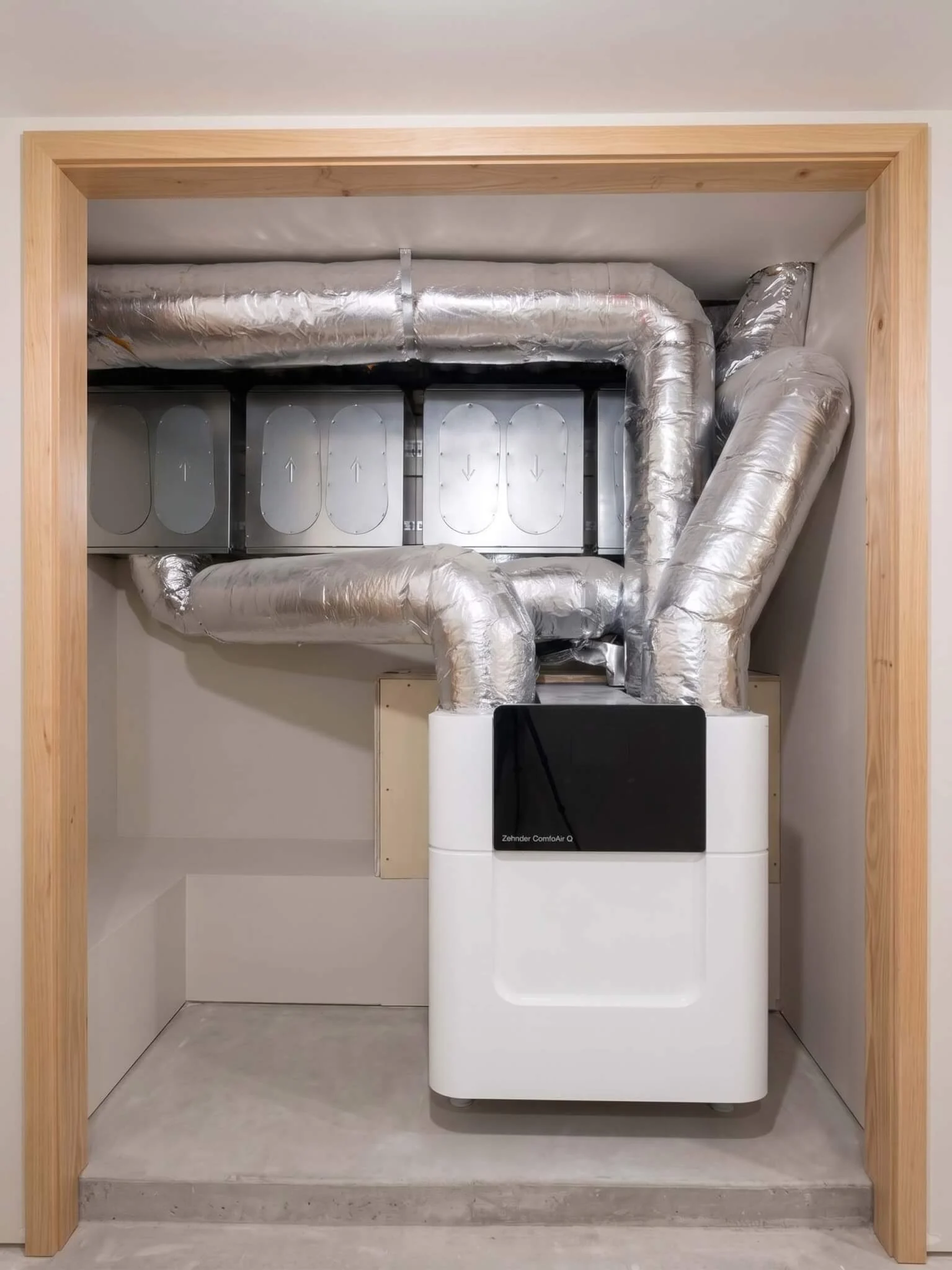
People, cooking, showers, furniture, and the ground all add to indoor air: carbon dioxide, moisture, odors, chemicals, and sometimes radon. Leaks and open windows can't be counted on to remove them: windows work only when wind and weather allow, and get shut when they don't. A Passive House ventilates continuously.
Every room people live in still has a window that opens, and opening it is fine: in monitored Passive Houses, residents who opened windows often used only a little more heat than their neighbors. On summer nights, open windows do the cooling. Fresh air every hour of the year takes the mechanical system, working with the airtight enclosure.
The system is balanced: one fan brings in fresh air, and another takes out the same amount. Fresh air usually goes to bedrooms, living rooms, offices, and classrooms, and stale air leaves from the kitchen, bathrooms, and utility rooms. It is planned as a cascade so the air crosses the halls and areas between the supply and exhaust. The two streams pass through a heat exchanger: in winter, the outgoing air warms the incoming air; in summer, it cools it; and in hot, humid climates, an energy recovery unit can also keep moisture out.
PHI requires at least 12 cfm of fresh air per person (and 0.30 air changes an hour), at least 75% heat recovery from a certified unit, fans that use no more than about 0.77 W per cfm, and bedrooms and living rooms no louder than 25 dB(A). Incoming air passes a fine filter, minimum MERV 13, which helps against wildfire smoke and traffic pollution. In monitored Passive Houses, carbon dioxide stays mostly below 1,000 parts per million.
Heat recovery doesn't cool the rooms, so the unit needs a summer bypass. And the system performs as designed only if it's balanced at handover and its filters are changed every three to six months.
Training on this topic
Filters (1)
13 courses and sessions
About Certification and verification →About Climate and carbon →About Enclosures →About Energy modeling and tools →About Mechanicals and ventilation →About Passive House basics →About Policy and codes →About Practice and business →About Resilience →About Retrofits and EnerPHit →
Certification courses 0
Certified Passive House Designer/Consultant (CPHD/C)
35 AIA LU|HSW
Live online · January 14
Certified Passive House Tradesperson (CPHT)
32 AIA LU|HSW · 16 PHI credits
Live online · In person
Specialized courses 2
Modeling Multiple Building Designs in a Single PHPP
1.5 AIA LU · 2 PHI credits
$49
Passive House Retrofits: The EnerPHit Standard
2 AIA LU|HSW · 3 PHI credits
$145
Thermal Bridging Calculations
14 AIA LU|HSW · 18 PHI credits
$395
PHPP Bundle
33.5 AIA LU · 22 PHI credits
$495
easyPH Training
2 AIA LU · 2 PHI credits
$49
designPH Training
3 AIA LU · 4 PHI credits
$49
Electrification, Passive House PER & California
2 AIA LU · 2 PHI credits
Live online
2025 California Building Energy Code Updates, Electrification & Passive House
2.5 AIA LU · 3 PHI credits
Live online
Schools & the Passive House Standard
2 AIA LU|HSW · 2 PHI credits
Live online
Passive House Retrofits: The EnerPHit Standard (Live Online)
4 AIA LU|HSW · 5 PHI credits
Live online
Building Certification Verification Requirements
3 AIA LU · 4 PHI credits
Live online · In person
Wildfire Resilience & Passive House
2 AIA LU|HSW · 2 PHI credits
Live online
Electrification & Decarbonization with Passive House
2 AIA LU · 2 PHI credits
Live online · November 18
Embodied Carbon & Passive House
2 AIA LU · 2 PHI credits
Live online
Passive House Mechanicals
2 AIA LU|HSW · 2 PHI credits
Live online
Passive House Enclosures
2.5 AIA LU|HSW · 3 PHI credits
Live online
FLIXO: Template Setup and Introduction
Matt Bowers, AUROS Group
Free
Introduction to Passive House Trades
4 AIA LU|HSW
$49
Introduction to Passive House
1 AIA LU|HSW
Free
Multifamily Passive House
3 AIA LU|HSW · 4 PHI credits
Live online
Passive House Windows
4 AIA LU|HSW · 4 PHI credits
$95
Paid sessions 7
Emu Report on Energy Standards: California Results
Enrico Bonilauri, Emu Passive; Ken Levenson, PHN (in conversation)
1 AIA LU · 1 PHI credit
Watch free · credit $1.99
The Dark Side of a Bright Future
Sam Bloch
1 AIA LU · 1 PHI credit
Watch free · credit $1.99
High-Density Results
Tomás O'Leary, Mosart; Cecil Scheib, New York University; Michael Syracuse, fxcollaborative
1.25 AIA LU · 1 PHI credit
$19
Mechanical Mastery
Matthew McGovern, Tower Enterprises; Faiz Malek, Swegon; Zachary Koch, Mitsubishi; Dylan Martello, Steven Winter Associates (moderator)
1.25 AIA LU · 1 PHI credit
$19
Home Security
Meredith McDaniel, MAAM Architects; Darin Dusan, Joubert Homes; Edie Dillman, B. Public Prefab; Jonah Stanford, B. Public Prefab; Anne Barrett, Yale University (moderator)
1.25 AIA LU · 1 PHI credit
$19
Refining Residences
Oliver Style, Praxis; Todd Poisson, BKSK Architects; Will Russell, BKSK Architects; Esther Van Eeden (moderator)
1.25 AIA LU · 1 PHI credit
$19
The Business Case
David Komet, Urban Earth; Bruce Becker, Becker + Becker; Mike Doty, Nuveen Green Capital; Stuart Decrew, Yale University (moderator)
1.25 AIA LU · 1 PHI credit
$19
Mechanical Control
Robb Aldrich, Steven Winter Associates; Andrew Peel, Peel Passive House; Narasimha Rao, Yale University (moderator)
1.25 AIA LU · 1 PHI credit
$19
Material Thoughts
Floris Keverling Buisman, 475 High Performance Building Supply; Mike Horgan, Cairn Collaborative; Caroline Dunn, Cairn Collaborative; Andrew Ruff, GOA Architecture (moderator)
1.25 AIA LU · 1 PHI credit
$19
Deep Multifamily
Crystal Ng, Curtis + Ginsberg Architects; Mark Ginsberg, Curtis + Ginsberg Architects; Elias Dagher, Pennoni; Lois Arena, Steven Winter Associates (moderator)
1.25 AIA LU · 1 PHI credit
$19
Keep it Fresh
Eric Richards, Systemair; Szabi Fekete, Zehnder America; Andrew Peel, Peel Passive House (moderator)
1.25 AIA LU · 1 PHI credit
$19
Community Built
Karen Ramsey, Building Wellness, LLC; Leo Cheng, ResilientHAUS; Jaime Rodriguez Jr., ResilientHAUS; Eddy Voltaire, Design Construction & Sustainability Inc. (moderator)
1.25 AIA LU · 1 PHI credit
$19
Pushing Forward
Matthew Bowers, Auros Group; Marine Sanchez, RDH Building Science (moderator)
1.25 AIA LU · 1 PHI credit
$19
More Optimization
Steve Hessler, New Energy Works; Louis Koehl, Handel; Gabrielle Brainard, SOM (moderator)
1.25 AIA LU · 1 PHI credit
$19
Step-By-Step
Nidhi Shah, RACE-Studio; Buck Moorhead, Buck Moorhead Architect; Roxanne Ryce-Paul, NYC School Construction Authority (moderator)
1.25 AIA LU · 1 PHI credit
$19
Care for Kids
Andrew Peel, Peel Passive House; Mike Fowler, Mithun; Sarah Smiley Smith, Yale University (moderator)
1.25 AIA LU · 1 PHI credit
$19
Standard Relations
Keith Saechao, Frontier Energy; Marine Sanchez, RDH; Bronwyn Barry, Passive House BB (moderator)
1.25 AIA LU · 1 PHI credit
$19
Journey of Improvement
Brandon Pietras, Bernheimer Architecture; Adam Watson, L&M; Cheryl Saldanha, SGH; Carlos Cardoso, Beyer Blinder Belle (moderator)
1.25 AIA LU · 1 PHI credit
$19
Pride of Place
George Kontaroudis, Ikc; Stas Zakrzewski, ZH Architects; Bria Josephs, b.a. forma (moderator)
1.25 AIA LU · 1 PHI credit
$19
Middle Matters
Hilary Padget, pHdesign; Anthony Harrington, pHdesign; Craig Toohey, Collective Carpentry; Nicholas Jones, Eversource (moderator)
1.25 AIA LU · 1 PHI credit
$19
Passive House Value
Jessica Grove-Smith, PHI; Vanya Chan, PHI; Timothy Lock, OPAL
1.25 AIA LU · 1 PHI credit
$19
Opening Plenary
Bruce Becker, Becker + Becker & Hotel Marcel; Vanya Chan, Passive House Institute; Mike Woolsey, Swegon; Katelyn Meehan, Wells Fargo; Darren Macri, Wythe Windows; Ken Levenson, The Passive House Network
1 AIA LU · 1 PHI credit
$19
State of Change
Alexander Gard-Murry, Passive House Massachusetts; Paul Ormond, Massachusetts Department of Energy Resources
1.25 AIA LU · 1 PHI credit
$19
Lessons Learned
Sarah Lewis, Passivhaus Trust; Beth Campbell, Passive House Massachusetts
1.25 AIA LU · 1 PHI credit
$19
Passive House Certification Tips from a Passive House Certifier
Matt Bowers, AUROS Group
1 AIA LU · 1 PHI credit
Watch free · credit $1.99
Passive House & Resilient Design in the Face of Fire
Andrew Michler, Hyperlocal Workshop
1 AIA LU · 1 PHI credit
Watch free · credit $1.99
Multifamily Ventilation Duct Leakage: Targets, Strategies, and Lessons Learned
Kelly Fisher, Peel Passive House Consulting; Michael Schmidt, Steven Winter Associates
1 AIA LU|HSW · 1 PHI credit
Watch free · credit $1.99
Free sessions 4
Simplifying Passive House Multifamily Certification
Tomás O'Leary, Managing Director of Mosart
Live online · November 24
The Passive Pitch: Communicating the Value of Passive House
Mariana Pickering, Emu Systems
Free to watch
Millhaus Case Study: Finding Harmony Between Health, Comfort, and Performance
Greg Fisher, Greg D. Fisher, Architect
Free to watch
Pushing the Envelope: Climate, Comfort, and Opaque Component Certification
Enrico Bonilauri, Emu Systems
Free to watch
Stacking Up: Carrick Library, America’s First Certified Passive House Public Library
Brandon Nicholson, NK Passive
Free to watch
Getting Political: Lessons from Building Performance Policy Battles in Minneapolis
Tim Eian, TE Studio
Free to watch
Factoring in Electrification: Designs for a Renewable Energy Grid
Bronwyn Barry; Dylan Martello, Steven Winter Associates
Free to watch
Candela Lofts, Hoboken, New Jersey
John Nastasi, Nastasi Architects; Ed May, Bldgtyp
Free to watch
Seeing Clearly: How Quality Windows Drive Comfort, Performance, and Design Freedom
Cheryl Saldanha, Simpson Gumpertz & Heger; Ed May, Bldgtyp
Free to watch
Fundamentals of Online Marketing for Passive House
Johnny Rezvani, 475 High Performance Building Supply
Free to watch
Multifamily Buildings Energy Standards Report
Marine Sanchez, RDH Building Science; with Bronwyn Barry
Free to watch
Lloyd Alter and The Story of Upfront Carbon
Lloyd Alter
Free to watch
The Hidden Climate Impact of Residential Construction: A New Report from RMI
Chris Magwood, RMI
Free to watch
Dealing with Heat Waves: Can We Use the PHPP to Size Cooling Equipment?
Oliver Style, Praxis Resilient Buildings
Free to watch
Massachusetts Mandates Passive House Certification: What? Why? How? When?
Paul Ormond, Massachusetts DOER
Free to watch
Crafts Street Senior Housing: A New Pacesetter
John Martin, Elkus Manfredi Architects; Marine Sanchez, RDH Building Science
Free to watch
The IRA: Passive House Funding Opportunities Demystified
Amanda Clevinger and Ion Simonides, Bright Power
Free to watch
The Marshall Fire Journey: Homeowners and Teams Rebuilding Better
Susan Nedell; Kim and Juta Cinco, Baseline Design; Mark Attard, Hammerwell; Michelle and Peter Ruprecht; Rob Harrison, Harrison Architects; Chuck Bower, Joubert Botique Building; Kevin and Casey Lombardo; Morgan Law and Maggie Wohltjen, Shape Architecture; Frank Wetenkamp, Living Craft
Free to watch
The Waring New School: Stretching Passive House
Timothy Lock, OPAL
Free to watch
Introduction to Honeybee-PH: Software Support for Complex Passive House Design
Ed May, Bldgtyp
Free to watch
Keep Your Cool: Exterior Motorized Shading and Controls
Tim Eian, TE Studio; Igor Beletsky, Loxone; Floris Keverling Buisman, 475 High Performance Building Supply
Free to watch
Optimizing Form and Function: Meet Single Point Access Blocks
Michael Eliason, Larch Lab
Free to watch
Scaling Up All-Electric Buildings
Lois Arena and Dylan Martello, Steven Winter Associates
Free to watch
Keys to Successful Passive House Implementation in California
Mark Wilhelm and Matthew Joyce, Tierra Resource Consultants
Free to watch
How to Retrofit Buildings in a Climate Emergency: Stepwise EnerPHit
Monte Paulsen, RDH Building Science
Free to watch
Beneficial Electrification: Connecting Climate Justice and Decarbonization
Yu Ann Tan, RMI; Bomee Jung, Topsight Advisors
Free to watch
Scaling Up Passive House in Massachusetts: Policies, Incentives, and Educational Offerings
Beverly Craig, Massachusetts Clean Energy Center
Free to watch
Passive House in Practice – Rebuilding Better
Ed May, BLDGtyp; Maggie Wohltjen, Shape Architecture Studio
Free to watch
Pickleball Meets Passive House
David Komet
Free to watch
From Straw Houses to Straw Buildings: Lessons from France
Martin Paquot, Topophile
Free to watch
From PHPP to Peak Cooling: When Further Analysis Is Needed
Scott Stewart, LAB Design
Free to watch
Passive House as Climate Education
In Cho, Pratt School of Architecture and Passive House for Everyone!
Free to watch
Panelized Prefab: Building Confidence in Passive House Construction
Heather Mott, Collective Carpentry
Free to watch
PHPP, Practice & Pedagogy: Passive House on Campus
Joseph Dobbs, Fort Hays Tech | Northwest; Paul Kealey, EkoBuilt
Free to watch
Reclaimed Wheat Straw for Passive House and Low-Carbon Design
Maria Giatrelis; Steve Layfield
Free to watch
What Are You Sleeping With?
Walter Lourie, mafi Naturholzboden
Free to watch
Introduction to Hemp as a Sustainable Material
Greg Wilson, HempWood
Free to watch
Multifamily ERVs: Centralized or In-Suite?
Erdem Kokgil
Free to watch
Site Planning for High Performance Homes
Nora Meehan, Ecotone Home; Galen Smith, Ecotone Home
Free to watch
Solar and All Things Passive
Victor Olgyay, Green Design Collaborative; Brett Little, GreenHome Institute; Debbie Coleman, Sun Plans
Free to watch
EnerPHit and Deep Energy Retrofits: A Verifier’s Perspective
Benjamin Cohen, Re-Vireo
Free to watch
The Marnix: From Passive House to Regenerative Architecture – Retrofitting a 1965 Modernist Landmark
Sebastian Moreno-Vacca, A2M
Free to watch
High-Performance Bio-Based Materials: Wood and Beyond
Jesce Walz, Perkins&Will
Free to watch
High-Performance Housing as Environmental Equity
Rachel Ehrlich, Dattner Architects; Shefali Sanghvi, Dattner Architects
Free to watch
Bio- and Mineral-Based Enclosures for Cold-Climates
Lindsey Love, Regenerative Building Solutions; Lisa Morey, Nova Terra
Free to watch
Passive House + Foundation Reuse
Anika Linde; Dawson Linde, Lime Tree Carpentry; Greg Fisher, Greg D. Fisher, Architect; Ed May, bldgtyp
Free to watch
Shading Devices for Energy Efficiency and Comfort
Cyril Petit, CPHBA
Free to watch
Passive House x Fire Hardened: A Shared Ethos
Marcos Santa Ana, Alloi Architecture + Construction
Free to watch
SIPs for Passive House: Airtightness, Moisture Control and High-Performance Detail
Todd Bell, Premier Building Systems
Free to watch
Ventilation Control in Extreme Climates
Szabi Fekete, Zehnder America
Free to watch
How A Wide Net Makes Hyper-Local Solutions
Marcy Conrad Nutt, Yarrow Architecture
Free to watch
Design Coordination when Building a Passive House
Michael Wilks, Bauen Build; Matt Brill, Bauen Build; Steve Scribner
Free to watch
Hidden Impacts of Plastic Building Products
Rebecca Stamm, Habitable
Free to watch
3,467× Better: Future-Proofing with AWHPs and Hydronics
Kristof Irwin, Positive Energy; Hap Pfeil, Positive Energy
Free to watch
Modular Thinking, Modular Process, Modular Passive House
Grayson Jordan, Paul A. Castrucci Architects
Free to watch
Passive House Prefab for Everyday Builders
Mariana Pickering, B.Public Prefab
Free to watch
Right-Sizing Electric Hot Water Systems
Tom Sottile, Sunamp
Free to watch
Quitting Carbon in Quebec: PHPP, BEAM and Real Data
Evelyne Bouchard, Tandem Architecture Écologique
Free to watch
Your PH Toolbox: designPH, easyPH, and PHPP
Vladimir Pezel, eMod Studio
Free to watch
Rebates and Resilience: Lessons from a Marshall Fire Rebuild
Kristen Uitto, Caddis Collaborative
Free to watch
Passive House, HVAC System COP, and Value Engineering: A Much Needed Perspective
Barry Stephens, Ventacity Systems
Free to watch
The Anarchy of Good Buildings Amid Sustainability Frameworks
Timothy Lock, OPAL
Free to watch
Demystifying Ventilation
Gabrielle O'Grady, 475 High Performance Building Supply
Free to watch
High-Performance Infill: ADUs + Passive House
Tyler Whaley, Geometry & Materials
Free to watch
Foam Free High Performance Building Enclosures
Nick Shaw
Free to watch
What’s in a name? History and precedents to PassivHaus
Brian Pearson, Studio Pear
Free to watch
From Cabin to Campus: Low-Carbon Passive House at Every Scale
Cillian Collins, Perkins&Will
Free to watch
Advanced Fenestration Science and the Building Envelope
Darren Macri, Wythe Windows
Free to watch
From One Apartment to Many: Replicable EnerPHit Retrofits Across Climates
Francesco Nesi, ZEPHIR Passivhaus Italia
Free to watch
Solving Performance Demands with Wood Fiber Insulation
Kali Sipes, TimberHP
Free to watch
What Are the Actual Hoops to Meet Passive House Certification?
Melissa Furukawa, Peel Passive House
Free to watch
D.C. Code Compliance: Passive House
Ashley Delgado
Free to watch
The Catskill Project: Scaling Decarbonized Single-Family Housing
Buck Moorhead, Buck Moorhead Architect; Remy Moorhead, Buck Moorhead Architect
Free to watch
It’s Energy Efficient, but Is It Healthy?
Rick Hall, Building Science Professional Training (BSPT LLC)
Free to watch
Plant Based and Future-Proof: High-Performance Biomaterial Prefabs
Andrew Frederick, Croft
Free to watch
Compliant Isn’t Comfortable: Tropical Passive House Down Under
Marcelo Haag, Maxa Design
Free to watch
Fire-Wise Property Hardening: Life Safety, Insurance, and Passive House Building
Free to watch
From Code to PH Standard: A Denver Home Changes Route
Mark Attard, Point 6 LLC
Free to watch
Financing and Valuing Passive and High-Performance Homes
Teresa Lopez
Free to watch
Refrigerants, Regulations, and Real-World HVAC Solutions
Kian Moozar; Brendan Grace, SpacePak Central Air
Free to watch
Passive House Certification Revealed
Free to watch
Certified to Perform: Lessons from a PHI-Accredited Component Assessor
Melissa Furukawa
Free to watch
AI Meets Passive House: From Algorithms to Airtightness
Ed May, BLDGTYP
Free to watch
Don’t Judge a House by Its Cover: Natural Materials in Residential Design
Free to watch
Renovation and Resilience: Lessons from a Panelized Deep Retrofit
Michael Hsueh, RDH Building Science
Free to watch
Passive House Cooling Strategies
Tim Eian, TE Studio
Free to watch
Passive House Strategies in Warm, Hot, and Humid Climates
Enrico Bonilauri, Emu Passive
Free to watch
The Standard on Fifth: Multi-Family Passive House
Rebecca Griffith, Rothschild Doyno Collaborative; Jason Andrews, Rothschild Doyno Collaborative
Free to watch
Window to the Future: Mexico’s First Certified Passive House Component
Goerdt Abel, Aventa Windows; Edward Lowes, Passive House Institute
Free to watch
Dude, Where’s My Carbon? The Hidden Impact of Building Materials – Analyzing embodied carbon in Passive House design
Ben Leer, Emu Passive
Free to watch
Beyond Residential: Designing Non-residential Buildings to Passive House Standards
Enrico Bonilauri, Emu Passive
Free to watch
Passive House meets Open-Air Sauna?
Oliver Style, Praxis Resilient Buildings; Andrew Straus, Consinfra; Enrique Bueno, E+ Buildings
Free to watch
Scaling Sustainability: Lessons from Boston’s Leadership in Passive House Adoption
Esther Van Eeden, Kristen Brozowski, and Maria Navarro, Buro Happold
Free to watch
PHN Presents: California, Wildfires, & Resilience
Mike Horgan, Cairn Collaborative Design-Build
Free to watch
PHI-LEB Multifamily: Demystifying the Low Energy Building certification metrics and strategies in multifamily buildings
Dylan Martello, Steven Winter Associates
Free to watch
Passive House and Fire Resilience: Building Forward
Birgitte Messerschmidt; Andrew Michler
Free to watch
Fire Weather, Urban Conflagration, and Community Resilience: Defensive Strategies & Lessons Learned
Stuart Mitchell, Wildfire Mitigation Advisors
Free to watch
Fire Rebuild Competition: Catalog & Winning Team Insights
Christian Kienapfel, Paravant Architecture; Steve Mann, Home Energy Services; Timothy Lock, OPAL; Laura Lubniewski, University of Buffalo; Katie Seftas, Moss Architects; Jim Bischoff, Moss Architects; Roussa Cassel, Artisans Group Architecture + Planning
Free to watch
Building For People
Michael Eliason
Free to watch
Are we measuring the same thing? How HERS and Passive House provide different answers to different questions.
Graham Irwin, Essential Habitat Architecture
Free to watch
52 New Street: Community, Ambition, and Passive House in Cambridge, Massachusetts
Ben Wan, RODE; Madeline Lee, Just A Start
Free to watch
Rainscreen Sub-Framing Systems: Essential to Envelope Success
Kica Loliyong, exo-Surfaces
Free to watch
The Homeowner’s Journey
Ryan Downey and Jessica Bodford; Malcom Flemming; moderated by Edie Dillman, B.PUBLIC Prefab
Free to watch
Passive House Building Blocks: Tricky Transitions
Ben Olender, 475 High Performance Building Supply
Free to watch
Nothing matches all of these choices. Try removing one, or clear them all.
Writing on ventilation 4
When the air outside is dangerous…
When air quality alerts go out across New York City—as they did last week, with smoke from wildfires burning in Canada settling over the…
Are You Healthy? Passive House and the Hygiene Standard
An unhealthy environment? In your standard building? It’s more likely than you think.
Ventilation Unit Test Data: A New Report
As our climate emergency bears down, the importance of ventilation data and performance only rises. Passive House practitioners have been frustrated by the lack…
Open Windows and Ventilation
Several construction concepts exist that intend to dramatically reduce building energy consumption. Among the concepts is Passive House, which describes ways to design and…