How all-electric, multi-family Passive House buildings deliver comfortable, cost-effective climate resilience.
A report by The Passive House Network · July 2023 · Download the PDF · All reports
Published in 2023; figures and programs are as of then. Current codes and incentives: Building Codes and Building Financial Incentives. Covered by The Wall Street Journal, the Chicago Tribune, Building Design+Construction, and Business Insider.
On this page: Executive Summary · Topline Findings · Part 1: Introduction · Staying comfortable in extreme heat & cold · Protecting the air we breathe at home · Bye-bye heating & cooling bills · Part 2: Building trends & multi-family cost parity · Analysis: What does it cost to build with Passive House? · Part 3: A centerpiece for states’ building decarbonization strategies · How New York became a Passive House leader · New regions embrace Passive House · Part 4: Accelerating mass-scale adoption of multi-family Passive House · Passive House Network policy recommendations · Credits · Notes
Executive Summary
As the 21st century advances, each passing year reinforces the fact that America has two kinds of housing—in buildings that are prepared for climate change, and in buildings that are not. One of the most pressing community resilience issues facing the nation is that we’re building too much of the wrong kind of housing, which needlessly delays pollution cuts and makes us ill-prepared to withstand the extreme weather and climate disasters that are becoming hallmarks of the climate crisis.
And yet, one solution is gaining steam. The U.S. is experiencing an unprecedented construction boom for buildings that use Passive House design. Passive House is a green building energy standard that ensures buildings consume minimal amounts of energy – a feature that significantly reduces household energy bills as a result.
As utilization of Passive House picks up, data is revealing that these buildings have hit a crucial milestone. In many regions of the U.S., all-electric multi-family Passive House projects are being constructed at the same cost or close to the same cost as conventionally designed buildings. Combining an experienced design and construction team with incentive programs surpasses another milestone—all-electric multi-family Passive House buildings can be cheaper to build than standard.
With no economic barrier to building smarter buildings, there is simply no excuse to continue business as usual, particularly because the benefits of Passive House are immense.
This study finds that if the U.S. moves to investing only in Passive House buildings and retrofitting buildings to be all-electric Passive House, greenhouse gas emissions from the building sector will fall dramatically. Residents of Passive House buildings benefit from lower energy bills, and healthy, pollution-free living spaces that are resilient to extreme heat and cold, intense storms, power blackouts, and more.
The well-insulated and airtight envelope of Passive House creates unmatched efficient space heating and cooling, which lowers the burden on the energy grid during periods of extreme heat and extreme cold. This design is complemented by HVAC systems that draw in continuous supplies of clean, fresh and filtered air while removing stale air from living spaces – a critical design feature that will protect residents from the wildfire smoke and other hazardous air pollutants such as ozone that have become common across the nation.
But despite the recent boom in Passive House construction, the vast majority of buildings in the U.S. do not employ these measures. This report relies on research and interviews conducted with experts from regulatory, policymaking, and affordable housing sectors, as well as the building industry more broadly. Almost without exception, these experts identified a primary roadblock to mass-scale adoption of all-electric multi-family Passive House buildings in the U.S. — systemic inertia.
The building industry, regulators and policymakers, utility companies, affordable housing agencies, and many other stakeholders who decide how housing is constructed in the U.S. tend to favor incremental change. By its nature, Passive House represents a bold shift away from conventional building practices. Policy action is needed to deliver these healthy, resilient, affordable, and comfortable homes for all.
There has never been a better moment to push all-electric multi-family Passive House to mass-scale adoption. The landmark Inflation Reduction Act contains $4.5 billion in rebates that will reduce the cost of building affordable all-electric, multi-family Passive House buildings, as well as tax credits that can be worth as much as $5,000 per unit. The IRA also includes $1 billion that state and local governments can use to adopt energy codes that spur Passive House. Leveraging this funding to support all-electric multi-family Passive House needs coordinated efforts at multiple levels of government, and adoption in the market more broadly. As states work to achieve ambitious building decarbonization goals, all-electric multi-family Passive House buildings are an under-utilized, cost-effective strategy that deliver immense and immediate results.
Topline Findings
Passive House has reached cost parity with traditional buildings; generates ongoing savings
- New sources of cost data show that all-electric multi-family Passive House projects can be built at the same cost or close to the same cost as conventionally designed buildings.
- A survey of 45 multi-family Passive House buildings in New York and Massachusetts found the average cost to build is just 3.5% more than standard. Delving further into these numbers shows that experienced design and building teams is a crucial way to lower costs for Passive House projects.
- Thanks to incentives from utilities and affordable housing finance programs, multi-family Passive House buildings can be cheaper to build than standard projects. IRA incentives that are beginning to roll out in 2023 will decrease the cost of all-electric projects even more.
- Approximately 150 multi-family Passive House projects — or about half the total — in the U.S. are affordable housing, including many that have been developed through the federal Low-Income Housing Tax Credit program. Affordable multi-family Passive House is barely scratching the surface of its potential. From 2012-2021, the federal tax credit program funded more than 5,300 new multi-family projects nationwide.
- Passive House keeps household heating and cooling bills between 30-50% lower than average—and in some cases eliminates them entirely. This is a key strategy to combat energy price volatility.
Passive House is critical for climate resilience
- The worsening impacts of climate change are forcing an alarming number of U.S. residents to endure more extreme weather conditions and storms each year without adequate protection for their health, safety, and comfort.
- One recent poll found that 71% of U.S. adults have been personally affected by some form of extreme weather in the last five years.
- Passive House design is an essential climate resiliency and justice solution. Its robust, smoke-tight exterior envelope and high-performance HVAC systems provide filtered fresh air while keeping residents comfortable during extreme heat and cold.
- In June and July 2023, smoke from Canadian wildfires made air quality in many parts of the U.S. the worst in the world. For many residents of older, draftier homes, including low-income households, staying at home offered little respite because their buildings couldn’t stop smoke infiltration.
- In 2020, 25 million people had at least one day of unhealthy air due to wildfires.
- Studies have found that combining Passive House design with ventilation units outfitted with the right air filters effectively prevented wildfire smoke infiltration in homes.
- Because Passive House buildings lower energy usage by up to 80% compared to a standard building, they can effectively flatten wintertime heating loads—the peak demand for residential gas use in the U.S. This makes them an essential component to building electrification strategies, particularly in cold-climate states. Eleven cold-climate states account for 53% of residential gas consumption.
- In Massachusetts, multi-family Passive House is a fulcrum for heavy lifts in the state’s plans to transition buildings off gas to meet legally required climate goals. Thanks to expected efficiency gains in buildings, the future peak demand on the power grid is forecasted to increase by a modest 5%.
Passive House is booming, but inertia hinders mass-scale adoption
- A decade ago, only a handful of multi-family Passive House buildings existed in the U.S. In 2023, a Passive House building boom is rippling outward from early adopter states like New York, Massachusetts, and Pennsylvania.
- Almost 16,000 units of Passive House multifamily housing (apartments or townhomes) were built or are in the process of construction nationwide. This includes approximately 275 projects encompassing about 15 million square feet of housing, most of which have been constructed or designed since 2018. Because some projects do not certify or are not listed in certification databases, this is a snapshot of a larger building trend.
- This is less than 1% of multi-family housing construction. In the past 10 years, the U.S. has built approximately 4 million units of multi-family housing.1
- To accelerate the pace of all-electric multi-family building that use Passive House design, including affordable housing, local, state, and federal policymakers should look to four key areas: Financing incentive programs, professional training, increasing Passive House provisions in states’ affordable housing programs, and including alternative compliance pathways and opt-in requirements.
About the Passive House Network: The Passive House Network (PHN), formerly known as NAPHN, is a high-performance building literacy program. We provide comprehensive, high-quality Passive House education to stakeholders across the building industry – from architects and engineers, to builders and developers, to regulators and policymakers. We demystify the impact of design and construction choices, form knowledge-sharing networks, raise expectations, and transform how professionals fundamentally think and work.
Passive House is widely recognized as the most powerful tool we have today to produce buildings that rise to meet our challenges, forming the cornerstone of climate mitigation and adaptation, public health, and equity impacts.
Part 1: Introduction
What will keep a hot liquid warmer, a plastic cup or a YETI thermos? When there’s a blizzard outside, would you step out wearing a light sweater? These analogies demonstrate the importance of a little-noticed part of every building—the envelope. This is what connects a building’s exterior to its indoor spaces and is a key factor in determining whether the building will be well-insulated or drafty. Thanks to superior insulation, high-performance building materials, a tight envelope, and HVAC systems, Passive House buildings are well-sealed yet comfortable to be in. Many homes, particularly older ones predating modern building codes and standards, have the equivalent of a light sweater protecting the residents inside.
These older homes were built for a climate that no longer exists. The worsening impacts of climate change are forcing an alarming number of U.S. residents to endure more extreme weather conditions and storms each year without adequate protection for their health, safety, and comfort. Because of historically racist development practices and housing policies combined with other environmental injustices, low-income residents and communities of color live in areas with higher air pollution burdens, such as being near a major highway or road, industrial facility, or power plant. This housing is often older, draftier, and thus more prone to air pollutant infiltration as well as poor indoor temperature regulation.
Passive House design is an essential climate resiliency and justice solution. Its airtight seal and high-performance HVAC systems provide filtered fresh air while keeping residents comfortable during extreme heat and cold, and keeping household heating and cooling bills shockingly low—or even eliminating them altogether. The well-sealed design also shuts out noise—a huge benefit to quality of life in major cities. Trains and trucks rumble by and tenants don’t hear it.
What makes a Passive House?
- Continuous insulation used in an airtight building envelope that prevents infiltration of outside air and loss of conditioned air,
- High-performance windows and doors to manage heat,
- A ventilation system that combines a high level of heat recovery while providing continuous filtered fresh air in a well-distributed and balanced manner
- A space heating and cooling system that will be much smaller than conventional buildings.
Staying comfortable in extreme heat & cold
Climate change is making the simple act of staying home more dangerous. It’s a primary cause of the growing number and increasing severity of heat waves in summer months. It’s also a factor in weakening the earth’s polar vortex, which has caused a series of bitterly cold winter storms to hit states in recent winters. Extreme heat and cold can be fatal. A recent U.S. study found that an increase in days where it felt at least 90 degrees Fahrenheit outside was linked to an extra 1,373 deaths, on average, each year. In the next 30 years, almost two-thirds of the U.S. will experience at least three consecutive days exceeding 100 degrees each year, an increase from 48% currently. Researchers found hotter temperatures can put extra pressure on the heart, and that older adults, men, and Black adults were more likely to be affected. Extreme cold also has deadly consequences, such as the storm that hit Texas in February 2021 and knocked out power for millions of people for multiple days while causing hundreds of deaths.
When the power goes out during a cold snap, it takes 6 days and 8 hours for indoor temperatures to fall below 40 degrees in a Passive House, according to a 2020 study. Keeping indoor temperatures above 40 degrees is a critical safety threshold; a new code-compliant building will fall under that threshold in one day and 21 hours, while 1980s- and 1950s-era homes will do so in just 23 hours and 8 hours, respectively.
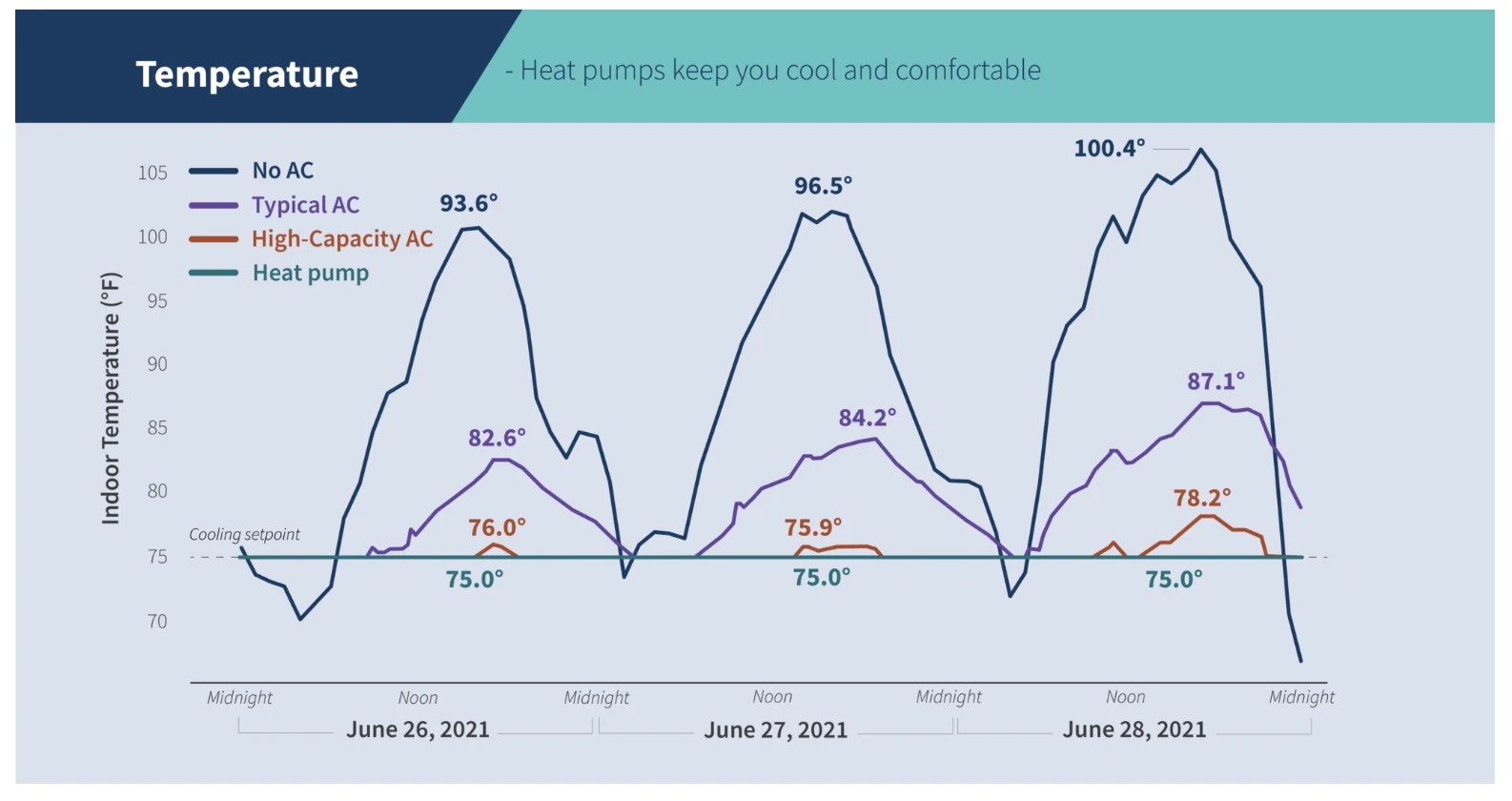
The need for space cooling is growing more urgent as more severe and longer heat waves occur every summer. In a three-day period in June 2021, one of the most extreme heat waves ever recorded in the Pacific Northwest hit Seattle. Heat pumps performed best at keeping indoor temperatures a comfortable 75 degree F while temperatures outside reached 108. In homes without air conditioning, indoor temperatures reached 96-100 degrees, while a standard AC could only keep temperatures between 82-87 degrees. In addition to being several hundred dollars cheaper to install and operate, heat pumps are much more energy efficient than a combination of a gas furnace and a traditional air conditioner. Exchanging an old, inefficient air conditioner with a high-efficiency heat pump can reduce energy use by up to 50%.
Protecting the air we breathe at home
Wildfire smoke is becoming one of the largest sources of air pollution in the U.S. In June, smoke from Canadian wildfires placed New York City’s air quality among the worst in the world. Nationally, these were the worst days for air quality in recent U.S. history. For many residents of older, leakier homes, including low-income households, staying at home offered little respite because their leaky buildings couldn’t stop smoke infiltration. People spend almost 90% of their time indoors.
Wildfire smoke affects millions of Americans annually, and has become so bad it’s threatening to undo decades of progress in cleaning up outdoor air quality. There is no safe level of wildfire smoke; particulate matter can lodge deep in lungs and even infiltrate bloodstreams. Breathing it has been linked to a variety of short-term respiratory problems as well as chronic heart and lung conditions. In 2020, 25 million people experienced at least one day of unhealthy air due to wildfire smoke. 1.5 million people are routinely exposed to levels that carry immediate risks, according to research by Stanford University.
Passive House buildings are the most effective at stopping infiltration of outdoor air pollutants like smoke. According to a 2020 study from Australia, combining Passive House design with ventilation units outfitted with the right air filters effectively prevented wildfire smoke infiltration in homes. This kept indoor air quality at healthy levels, even as pollutant levels spiked to extremely unhealthy levels outdoors. In leaky homes, the indoor air quality was almost as bad as being outside.
This works for many other kinds of outdoor air pollutants. The California Air Resources Board studied indoor air quality in existing multi-family housing. The study found that incorporating Passive House features, such as improved building envelopes and balanced energy recovery ventilation could reduce air pollutant infiltration by 3 to 11 times, while lowering HVAC energy use by 16-23% This also highlights the need to build with pollution-free, all-electric heating and cooking appliances. The CARB study warned that the airtight envelope without balanced ventilation could also trap air pollutants from indoor sources, like cooking on gas stoves.
A growing body of research finds that gas stoves expose residents to dangerous concentrations of pollutants, including benzene, a carcinogen. A Stanford University study found that cooking with gas is akin to living with an indoor smoker or near a power plant. Just 45 minutes of cooking time on a single burner or the oven resulted in benzene levels in kitchens similar to secondhand smoke, and range hoods and exhaust fans did not mitigate the hazard. Kids that live in a home with a gas stove are 42% more likely to develop asthma symptoms, and a recent study attributes 12.7% of childhood asthma cases to gas stove pollution.
Bye-bye heating & cooling bills
The poor energy efficiency of drafty homes delivers another blow—they must consume more energy just to stay comfortable. This drives up bills and has caused deep financial harm to low-income households in the past 18 months, because energy prices have skyrocketed.
In a 2020 survey, low-income households attributed dilapidated housing conditions such as holes in the wall or floor, mold, or poor insulation as among the leading reasons for being unable to pay a bill, receiving a disconnection notice, or having their service shut off. These households are also more likely to use fossil fuels in their homes, further exposing them to the price volatility that’s occurred since the start of 2022. Nationally, 54% of low-income households rely on fossil fuels for heating. In New York, Massachusetts, and California, it’s 84%, 75%, and 63%, respectively.
Nationally, gas and electric service disconnections have grown in recent years, even as utility companies’ reap billions of dollars in profits. From 2018-2022, 14.5 million customers lost service, a 24% increase from the five years prior. This increase occurred despite some utilities suspending disconnections during the Covid-19 pandemic.
This issue is also driving new interest in affordable all-electric, multi-family Passive House projects, because tenants in these buildings will pay dramatically lower energy bills. In Newton, a suburb of Boston, developers are constructing an 800-unit all-electric Passive House project, with 140 units of affordable housing. Developer Kent Gonzales of Northland Investment Corp., said the units will be so energy efficient that tenants will not have heating and cooling bills at all. Those utilities are projected to cost around $35-$55 a month— 70% lower than average — and can be factored into rents. Tenants will pay bills for lights and plugs and that’s it, Gonzales says.
In Chicago, developer AJ Patton is constructing two multi-family Passive House developments—one 60-unit mixed income project, and a 58-unit affordable housing project. They’re estimated to deliver between 33% and 50% savings on utilities for residents. Patton named his company, 548 Enterprise, after the apartment in the public housing complex he grew up in. He said his family’s apartment had its gas service shut off because his mother was unable to pay a $400 bill on a $10/hour wage. “For a year, I had to boil water to take a bath,” Patton says. “The issue of utility bills is very important to me. I’m doing two Passive House projects. Lowering the bills, health, and wellness is a big part of why I’m doing this.”
Studies have also shown that Passive House buildings result in steep reduction in utility costs. In New York City, a 2021 study found that a large multi-family Passive House building saved $155,000 annually on energy costs compared with a standard large multi-family building. Rooftop solar netted an additional $31,000 in savings. In Boston and Philadelphia, multi-family Passive House buildings are achieving 60% reductions in energy use, compared to standard.
Part 2: Building trends & multi-family cost parity
A decade ago, only a handful of multi-family Passive House buildings existed in the U.S. That’s no longer the case. In 2023, almost 16,000 units of Passive House multifamily housing (apartments or townhomes) were built or are in the process of construction nationwide, according to certification databases maintained by the Passive House Institute and Phius. This includes approximately 275 projects encompassing about 15 million square feet of housing, most of which have been constructed or designed since 2018. Because some projects do not certify or are not listed in databases, this data represents a snapshot of a larger building trend.
These numbers are set to soar. In hotbed states like Massachusetts, Pennsylvania, and New York, incentive programs and building codes are spurring construction of tens of thousands of units of multi-family Passive House buildings. Many of these projects are market-rate, so cost data are not disclosed by their developers. However, a growing number of projects in Pennsylvania, New York, and Massachusetts are enrolling in incentive programs and tax credit programs that disclose cost data, providing crucial windows into the costs of building multi-family Passive House projects. It’s important to note that the cost data featured in this survey does not include incentives from the Inflation Reduction Act, which will further decrease costs for all-electric appliances and certain building materials.
In New York, 33 multi-family Passive House projects were built or are under construction as part of the state’s Buildings of Excellence competition. These projects encompass 3,234 units, 3.5 million square feet, and cost to build is 4% higher than conventional projects, on average. In Massachusetts, cost data has been tracked for eight affordable multi-family projects as part of an incentive program. Encompassing 541 units and 634,000 square feet, the projects’ average incremental cost is 2.21% compared to conventional design. In Boston, a disclosure ordinance has allowed tracking of four more multi-family projects totalling 121 units; the average incremental cost is just 1.15%.
In Pennsylvania, several years of construction costs were tracked for multi-family Passive House buildings that were awarded federal low-income housing tax credits. The results showed that costs dropped from an initial average of 5.8% higher than similar code-compliant projects, to 1.6% within a year. Cost data also showed that seven of these projects were cheaper than conventionally designed buildings. Encompassing 366 units and 403,874 square feet, the projects’ average cost to build was $168 per square foot. Nineteen conventionally designed buildings won credits in the same program, and their average cost was $175 per square foot. Studies have found that Passive House costs lower as development teams gain more experience designing and building the projects.
Analysis: What does it cost to build with Passive House?
Building multi-family projects with Passive House design does require higher materials costs to pay for better insulation and windows, among other expenses, but many developers are discovering that it’s not as much as they originally thought. The extra costs can be as little as 1-4%, and that can be before incentive programs are factored in.
Because Passive House delivers enormous clean energy and energy efficiency benefits, clean energy programs and utility companies have begun investing in incentives. In Massachusetts, the Massachusetts Clean Energy Center and Mass Save, a utility-funded energy efficiency program, offer multi-family Passive House buildings incentives of $4,000 per unit and $3,000 per unit, respectively. Those can make Passive House cheaper to build than standard projects.
For an example, take this cost comparison for the affordable 98-unit Finch Cambridge Passive House project in Cambridge. The difference in cost amounts to $495,000, or 1.4% of the $36.7 million total — before incentives.
Finch Cambridge: base case and Passive House design costs
| Base case estimate | Passive House design | Difference | |
|---|---|---|---|
| Hard costs | $29,421,331 | $29,774,023 | |
| Insulation/thermal cost | $520,060 | $599,623 | $74,563 |
| Windows | $524,325 | $584,622 | $60,297 |
| Ventilation | $0 | $141,941 | $141,941 |
| Air sealing | $614,412 | $641,536 | $27,124 |
| Heating and cooling* | $1,778,273 | $1,778,273 | $0 |
| Water/hot water | $1,841,535 | $1,841,535 | $0 |
| Sunshades | $116,130 | $129,344 | $13,214 |
| Doors + hardware | $583,267 | $618,820 | $35,553 |
| SUBTOTAL | $352,692 | ||
| Soft costs | $6,300,687 | $6,443,115 | |
| Home energy rater | $40,300 | $85,740 | $45,440 |
| Energy modeling | $5,000 | $16,600 | $11,600 |
| Environmental consulting | $86,300 | $156,029 | $69,729 |
| Phius certification | $0 | $15,659 | $15,659 |
| SUBTOTAL | $142,248 | ||
| PROJECT TOTAL: | $36,217,139 | $36,712,259 | $495,120 |
*The heating and cooling systems for Finch Cambridge may have been less expensive than this estimate because they’re smaller
The MassCEC and Mass Save incentives for this project totaled $619,000, dropping the cost to $36,093,092—$124,047 less than standard. This is also prior to the rollout of Inflation Reduction Act rebates for electric appliances and tax credits worth up to $5,000 per unit.
Part 3: A centerpiece for states’ building decarbonization strategies
Like many cold-climate states, New York and Massachusetts have two primary energy grids serving seasonal heating and cooling demands—gas in the winter, and electricity in the summer. In the U.S., 53% of residential gas consumption comes from just 11 cold-climate states, including New York and Massachusetts. Because Passive House buildings effectively flatten wintertime heating loads, the design is a fulcrum to the heavy lifts in these states’ electrification plans that will decommission the gas grids without causing a resulting overload on the power grid.
Large chunks of the voluminous building and energy codes that exist in the U.S. today are hand-me-downs from an era of abundant, cheap fossil fuels. As a result, these codes require outsized, expensive heating and cooling systems that consume large quantities of energy, needed to disperse heat and cooling to rooms through the perimeter of buildings. The perimeter systems inevitably lose heat and cooling to the outside, compounding the inefficiency. These codes do not support good building envelopes.
In 2022, Massachusetts adopted a new stretch energy code that aims to reverse these long-standing practices. For a wide swath of building types, it prioritizes energy efficiency, better building envelopes, resizing HVAC systems, and reimagining how they distribute heating and cooling throughout buildings. While the code heavily incentivizes building all-electric, state law has arbitrarily restricted the number of communities that can require all-electric construction to 10 cities and towns. In 2023 climate advocates are urging lawmakers to expand the state’s electrification requirements so all new buildings are built all-electric.
Multi-family Passive House was a critically important part of this new code. Passive House uses a small, properly sized heating system, which is paired with a well-insulated, airtight building envelope. Cities can adopt an opt-in specialized stretch building code that requires every new multi-family building over 12,000 square feet to be Passive House. Communities representing 20% of the state’s population, including Boston, have adopted this new specialized stretch code. Combined with incentive programs, this has helped put an estimated 10,000 to 20,000 units of multi-family Passive House projects into the construction pipeline. The state analyzed the long-term impacts that this model of building electrification will have on the power grid, and found that it will result in a modest 5% increase in peak demand.
The vast majority of buildings in Massachusetts today or under construction in the next few years will still be standing in 2050. It’s will be prohibitively expensive to retrofit to get fossil fuels out, which is why the state can’t afford to build anything that isn’t 2050 compliant.
Massachusetts law requires at least net zero statewide greenhouse gas emissions by 2050, and the building sector accounts for about half of the overall emissions. The first prong of the state’s decarbonization strategy is to add renewable energy into the power grid to supplant the fossil fuels used to generate electricity. However, that only solves the electricity use in buildings and getting to a 100%-renewables grid wouldn’t achieve net zero by 2050. It gets between half to two-thirds of the way there. The gas grid is a separate, vexing challenge. Passive House is a crucial solution, because it doesn’t just lower energy use overall. It specifically crushes the wintertime heating loads. Relatively up-to-date energy codes, including versions from 2018 and 2021, can’t do this.
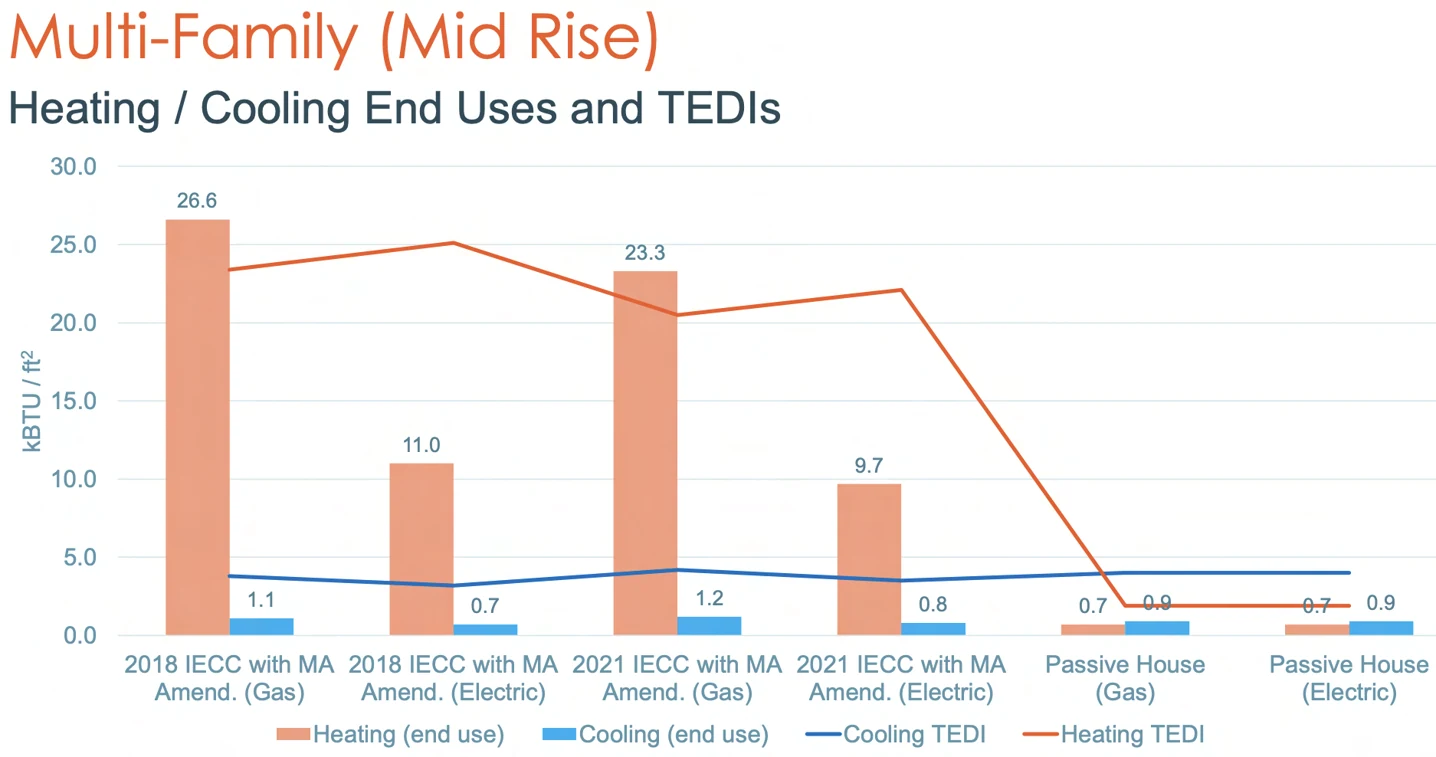
Passive House also avoids the costs of developing enormous amounts of renewable energy, allowing states to strategically deploy new clean energy capacity to decarbonize other sectors like transportation and industry. Consider this analogy highlighting the illogic of states’ current practice of maintaining and expanding both the gas and electricity grids to handle winter heating and summer cooling demands. It’s the same as a business building two warehouses, and only using one for part of the year while the other sits vacant. Transitioning off gas will save ratepayers billions of dollars in unnecessary infrastructure expenditures.
As Massachusetts is demonstrating, we don’t need to break our grids to electrify. States need better codes, because they can help eliminate the need for a gas grid entirely—and quickly. Passive House is a proven solution that results in better buildings.
How New York became a Passive House leader
In 2012, Ryan Cassidy and his colleagues at development firm RiseBoro Community Partnership had just finished construction on one of New York City’s first multi-family Passive House buildings. It was February and the temperatures outside were hovering around 20 degrees F. Cassidy said they knew they were on to something big when they went into one of the units. Not only was it warm inside, the heating system never needed to click on.
They were right. In the decade since then, RiseBoro became one of New York’s largest developers of Passive House and the city emerged as the national leader in multi-family Passive House development. The city now has two of the largest Passive House affordable housing projects in North America, the 34-story Sendero Verde and 26-story 425 Grand Concourse.
New York City embraced Passive House early as part of a broader emphasis on healthy, pollution-free buildings. From 2014-16, New York encouraged early adopters with subsidies for professional training and education. New York State now has three times more certified Passive House design building professionals than any other state. Professionals with experience in Passive House design are a key way to lower overall project costs, according to research.
NYSERDA, the state government’s energy research and development agency, created a three-year, $40 million “Buildings of Excellence” design competition. The program offers applicants as much as $1 million dollars in assistance, and has been a significant boost to multi-family Passive House. The first two of three rounds have been completed, and 33 of these projects including 3,330 units have received funding. In May 2023, the city Department of Housing Preservation and Development announced it was teaming up with NYSERDA for a $15 million incentive program that will give all-electric multi-family Passive House projects up to $10,000 per dwelling unit and up to $1.5 million per project.
In 2023, NYSERDA is in the process of evaluating a draft stretch code that incorporates Passive House, but codes and laws already in effect are aggressive in decarbonizing buildings. That means existing policies tend to favor Passive House projects, says Adam Watson, AIA CPHD, Director of Preconstruction Design with L+M Development Partners, which is building Sendero Verde alongside other Passive House projects in New York. “The stretch code is on a crazy fast trajectory and you have to grab on,” Watson said. “Say you’re doing Passive House and you zip past.”
Watson notes the policy landscape includes Local Law 97, which sets greenhouse gas emissions reductions targets of 80% by 2050 for the majority of buildings over 25,000 square feet. “When we put it up against other policies like Local Law 97, we’re meeting the 2050 mark with these Passive House buildings,” Watson said. “That controls a lot of risk.”
New regions embrace Passive House
From a building science perspective, Passive House works in every climate in every corner of the U.S. Yet, adoption in other states has not matched the pace of New York, Massachusetts, and Pennsylvania. That may be changing soon. In California, developers are beginning to incorporate more Passive House standards into their projects. That includes National CORE, which has developed 10,000 units of affordable housing in California and is the largest builder of affordable housing in the U.S., says Tim Kohut, an architect who works for the nonprofit. Kohut says the organization has been primarily focused on electrifying new construction and retrofitting projects to be all-electric, in addition to installing on-site solar panels to achieve net zero. However, many projects are “on the road” to Passive House, even if they don’t obtain certification at the end. Kohut said he expects the organization will soon test building a certified multi-family Passive House project.
In Chicago, developer AJ Patton is spearheading two multi-family affordable Passive House projects simultaneously. In 2022, the state government adopted an energy code that incorporates Passive House as a compliance option. Policy conversation at the city and state level are increasingly focusing on high-performance buildings and electrification, he said. “That’s what you’re seeing across the country,” Patton says. “People are going to follow where the market is pushing.”
In Colorado, the cities of Denver and Boulder have incorporated multi-family Passive House into their new energy codes. To help communities rebuild from devastation caused by the Marshall Fire in December 2021, Xcel, the major utility in Colorado, created an incentive program that encourages residents to build new homes using Passive House design.
In the Pacific Northwest, two dozen multi-family Passive House projects have been built or are in the construction process, including nine in Seattle. Advocates in Washington state are developing and refining strategies for accelerating this development trend. In Minnesota, market rate new multi-family Passive House projects with at least 20% affordable units can claim up to a $100,000 incentive. In Maine, starting in 2024 the state’s housing agency will be financing Passive House affordable housing. The U.S. Department of Housing and Urban Development recently announced a new $4.8 billion financing program that includes funding for Passive House retrofits.
Part 4: Accelerating mass-scale adoption of multi-family Passive House
The building industry, regulators and policymakers, utility companies, affordable housing agencies, and many other stakeholders who decide how housing is constructed in the U.S. tend to favor inertia, or incremental change if prodded to act. Passive House represents a bold shift away from conventional building practices.
It’s also rare for one idea to offer such immense cross-sector benefits. To protect health and safety as the threats of climate change increase, Passive House offers unrivaled, cost-effective climate resilience for Americans in every walk of life. For low-income residents and communities of color who have suffered for too long from energy inequity—unaffordable bills, underinvestment in clean energy infrastructure, and lack of access to energy-efficient housing—along with high air pollution burdens, Passive House is a crucial solution. For utility companies, regulators, and policymakers attempting to solve the building decarbonization puzzle on aggressive timelines, Passive House is an indispensable tool. It enables a quicker leap away from polluting, volatile, and expensive gas infrastructure and a softer landing onto a decarbonized, clean-energy power grid.
In 2023, unfortunately, progress in solving each of these problems has been hard-fought, and not on the scale or the pace needed to address climate change. The threats—and costs—of inaction and inertia grow each year. Yet, the policy tools we have to accelerate all-electric, multi-family Passive House development are effective and proven based on years of experience.
Passive House Network policy recommendations
To accelerate the pace of all-electric multi-family building that use Passive House design, including affordable housing, local, state, and federal policymakers should look to four key areas: Financing incentive programs, professional training, increasing Passive House provisions in states’ affordable housing programs, and including alternative compliance pathways and opt-in requirements.
Financial incentive programs
Programs like NYSERDA’s Buildings of Excellence and Mass Save’s Passive House Multifamily Program that operate outside baseline code are effective in accelerating Passive House growth. Half of the states in the U.S. require utilities to reach energy savings targets through energy efficiency programs. Thirteen of these states specifically require investment to support low-income customers or communities of color. These are a perfect fit for supporting all-electric, multi-family Passive House projects, including helping incentivize affordable housing projects.
The Inflation Reduction Act could be used to accelerate all-electric multi-family Passive House. The landmark federal climate law allocates $330 million in funding for states and municipal governments to adopt energy codes that meet or exceed the latest version of the International Energy Conservation Code as well as energy codes from ASHRAE. The law also earmarks $670 million for states and local governments to adopt zero-energy stretch codes, which could be a major driver of multi-family Passive House projects.
The law will deliver $4.5 billion to state energy offices to establish rebate programs, which can be used for installing heat pumps and induction cooktops along with other electric appliances. This funding will help lower the overall cost of all-electric multi-family Passive House buildings. The law also extends a tax credit program until 2032 that can be claimed by developers of multi-family Passive House and can be worth up to $5,000 per unit.
However, successfully leveraging this funding to support all-electric multi-family Passive House will take coordinated effort from policymakers and regulators at multiple levels of government, and adoption by the market more broadly.
Professional education
Professional training support is a key means of increasing the rate of Passive House adoption. Experience has shown that this is a vital ingredient in the early stages of accelerating multi-family Passive House development, although alone it is insufficient to drive widespread adoption.
New York supported and encouraged early adopters via subsidies for Passive House professional training. From 2014-2016, NYSERDA provided $500 per person to directly offset tuition costs payable towards a Certified Passive House Designer or Consultant (CPHD/C) training or Passive House-specialty course. After the funding for the program had been depleted, a critical mass of Passive House-qualified professionals had been established. This helped induce more building professionals to take the training on their own.
Similarly, the province of British Columbia in Canada provided training subsidies via two programs, WorkBC and BCIT. The BC training subsidies are still in operation and have been increased and replicated in other provinces across Canada.
In Connecticut, EnergizeCT recently launched a Passive House training subsidy program. Following the path of other states, this is expected to be followed by a project incentive subsidy program aimed at multifamily buildings, similar to the one operated by Mass Save. In California, utility PG&E and 3CREN, a regional energy network in the Central Coast, have been supporting Passive House professional trainings. Professional training subsidies are foundational to the successful rollout of project incentive programs.
Affordable housing
Despite an early breakthrough, affordable, multi-family Passive House has barely scratched the surface of its potential. From 2012-2021, the federal government’s primary method of building affordable housing, the Low-Income Housing Tax Credit program, allocated credits worth $46.2 billion to construct 5,375 multi-family projects including approximately 400,000 units. Only approximately 150 of these projects were Passive House.
In Pennsylvania, Passive House advocates achieved a breakthrough in 2015. The Pennsylvania Housing Finance Agency agreed to add a bonus in the scoring rubric that determines which projects receive LIHTC funding, which awarded 10 points for projects seeking Passive House certification. The experiment became a success story. In the first two years, 58 out of 179 proposals for tax credits were for multi-family Passive House, and 26 were awarded credits resulting in about 900 units of affordable Passive House being built.
Passive House developer Tim McDonald, one of the original advocates of this policy shift in Pennsylvania, sought to replicate it in more states. In response, 18 more states added Passive House to their tax credit programs, but few experienced the same level of success as Pennsylvania.
Researchers investigated why the vast majority of the other states were not able to replicate Pennsylvania’s success and found three key factors:
- The tax credit process must be competitive
- In the scoring rubrics used to determine who is awarded tax credit financing, Passive House points must be significant. Pennsylvania awarded 10, for example, and Virginia is now also awarding 10 points.
- Passive House must be allocated separately from simpler, less focused green certifications.
Massachusetts and New York have successfully incorporated multi-family Passive House into their affordable housing programs. In Massachusetts, 86 multifamily buildings were pursuing Passive House certification in 2022. The majority of those projects are affordable thanks to incentives added to the state’s tax credit program. In New York, 25 out of the 32 multi-family Passive House projects in NYSERDA’s Buildings of Excellence incentive program are affordable housing.
Alternate Compliance Pathways and opt-in requirements
Alternate compliance pathways and opt-in requirements that include Passive House are more effective at generating rapid transformation.
In places where this option has been most successful, state and municipal governments paved the way by approving Passive House energy models as alternate compliance options to baseline energy code models. This small code amendment has lowered the barrier of entry significantly. It eliminates the need for project teams to produce two energy models for all projects which reduces project development costs.
Policy experts have noted that in regions such as Washington state, alternate compliance pathways exist but have not been paired with Passive-House specific incentive programs, and Passive House adoption has not scaled as rapidly. This indicates that alternate modeling compliance pathways and incentive programs work symbiotically. They should be implemented together for best outcomes.
Massachusetts and British Columbia are two jurisdictions that have effectively implemented opt-in requirements to build multi-family Passive House through their building and energy codes. In British Columbia, the provincial government adopted a building performance-based step code in 2017, and gave local jurisdictions the decision to opt-in to enacting it. As of 2021, 79 jurisdictions had done so, while the city of Vancouver has adopted its own zero-emissions buildings policy. The step code requires builders to meet Passive House standards.
This is similar to the approach taken by Massachusetts and under consideration in New York. This policy approach should serve as a model for other states. In Massachusetts, local jurisdictions can now opt-in and adopt Passive House as a code requirement for large multifamily buildings. Regulatory requirements, like those in Massachusetts, that leapfrog code minimums will get to the end game of Passive House performance faster.
Credits
Thank you to the following people who shared their time and expertise in the research phase of this report:
- Adam Watson, L+M Development Partners
- AJ Patton, 548 Enterprises
- Beverly Craig, Massachusetts Clean Energy Center
- Bronwyn Barry, Passive House Network
- Ken Levenson, Passive House Network
- Kent Gonzales, Northland Investment Corp.
- Paul Ormond, Massachusetts Department of Energy Resources
- Ryan Cassidy, RiseBoro Community Partnership
- Sara Bayer, Magnusson Architecture and Planning
- Tim Kohut, National CORE
- Tim McDonald, Onion Flats
- Zack Semke, Passive House Accelerator
Primary Author: The Passive House Network
Notes
- An earlier version of this report relied on an inaccurate federal data source, and thus incorrectly stated the total number of units of multi-family housing construction in the U.S. The correct figure has been updated.